

Cart
0
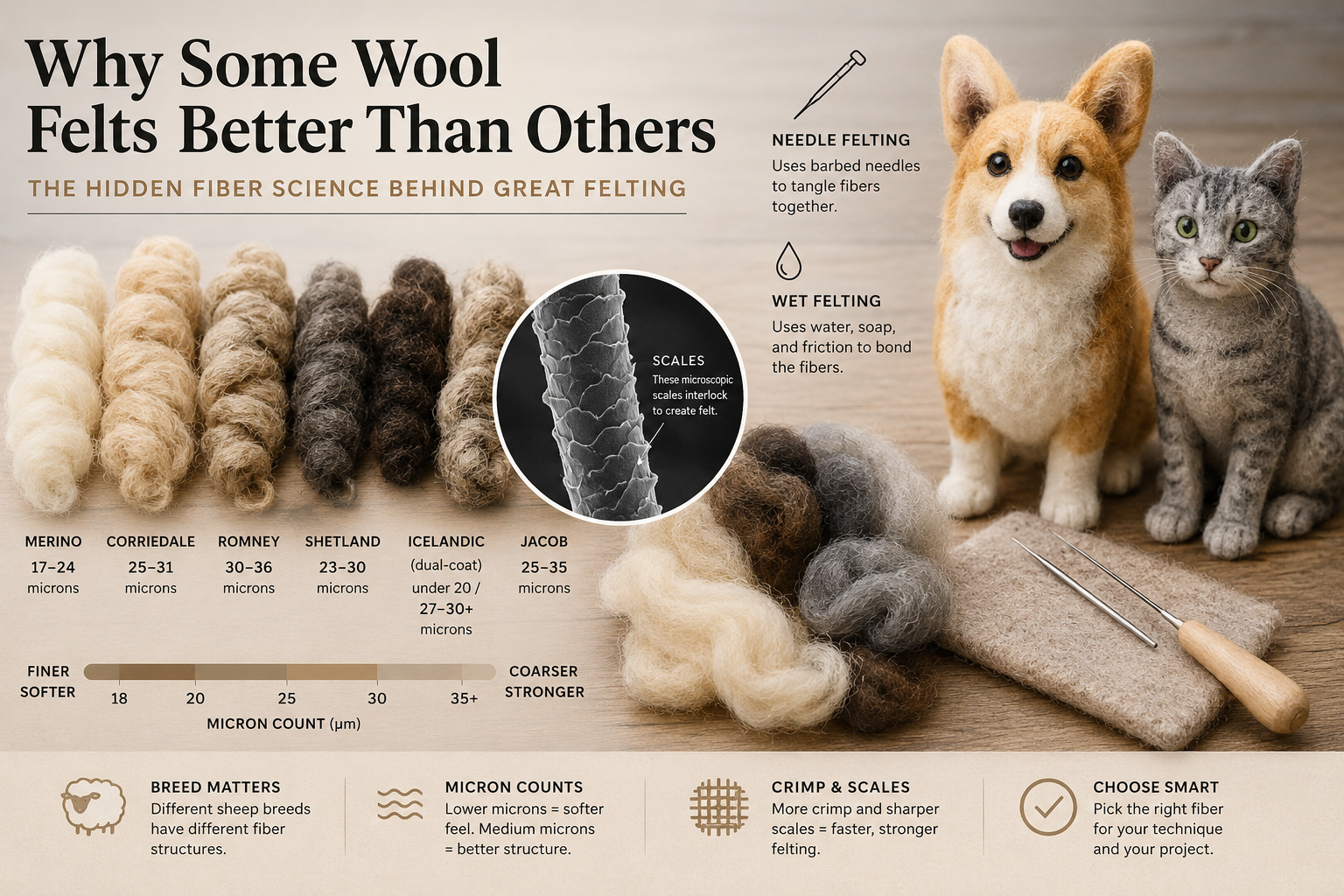
If you've ever needle-felted with two different "100% wool" rovings and gotten wildly different results — one fluffy and slow to bond, the other locking together almost instantly — you've already discovered something most beginner tutorials never explain: wool is not one material. It's dozens of materials wearing the same name.
Most felting guides start with "how to stab a needle" or "how to agitate soapy water." This one starts a layer deeper — with the actual fiber structure that makes felting possible at all, and why your choice of sheep breed matters more than your choice of technique.
How Wool Felting Actually Works, at the Fiber Level
Felting isn't glue, and it isn't weaving. It's a mechanical interlocking process made possible by the physical structure of the wool fiber itself.
Quick answer: Wool felts because each fiber is covered in microscopic, overlapping scales (the cuticle layer). When fibers are agitated — by moisture, heat, friction (wet felting), or repeated needle punctures (needle felting) — these scales catch on each other, ratchet together in one direction, and lock the fibers into a permanent, irreversible mesh.
This is also why felting is one-directional and non-reversible: once the scales interlock, you cannot "unfelt" wool back into loose fiber without destroying it.
Two structural features of wool determine how easily this happens:
- Scale density and shape (the cuticle) — Finer wools have more scales per unit length and scales that protrude more sharply, which means more "grip points" for interlocking.
- Crimp (the natural waviness of the fiber) — Highly crimped fibers pack together more densely and create more contact points per square inch, accelerating felting.
This is why synthetic fibers and most plant fibers (cotton, linen) essentially cannot felt on their own — they lack a scaled cuticle. It's also why superwash wool (chemically treated to smooth or strip the scales, usually for machine-washable yarn) famously refuses to felt, a fact that trips up even experienced fiber artists.
Micron Count: The Number That Predicts Felting Behavior
In the wool industry, fiber fineness is measured in microns (millionths of a meter) — the average diameter of the fiber. This single number is one of the most useful predictors of how a wool will behave in your hands.
| Micron Range | Feel | Felting Speed | Best Use |
|---|---|---|---|
| Under 20 microns (e.g., fine Merino) | Very soft, almost no prickle | Fast, fine-grained felting | Wearables, baby items, smooth-surface sculptures |
| 20–27 microns (e.g., Corriedale, Romney) | Medium softness, slight texture | Moderate, forgiving | General needle felting, beginner projects, core wool |
| 27–35 microns (e.g., Jacob, Icelandic outer coat) | Coarse, textured | Fast but visibly textured | Structural armatures, rustic sculptures, rugs |
| 35+ microns (e.g., some Karakul, carpet wool) | Very coarse, wiry | Felts fast but rough finish | Industrial felt, heavy-duty mats, not for skin contact |
Rule of thumb: the lower the micron count, the softer the wool — but counterintuitively, very fine wool can sometimes felt more slowly under the needle because the fibers are so fine they slip past barbed needles rather than catching. This is why many experienced needle felters use a coarser "core wool" for shaping the bulk of a sculpture, then wrap it in fine Merino for a soft, detailed outer layer — a two-fiber technique rarely covered in beginner content.
Breed-by-Breed: Choosing Wool for Your Project
Merino (typically 17–24 microns)
The finest commercially available wool. Excellent for wet felting garments, scarves, and anything touching skin. Less ideal as a standalone needle felting core because it can feel slippery and slow to hold shape under repeated needle punctures.
Corriedale (25–31 microns)
Often called the "workhorse" fiber of needle felting. Balanced softness and grip — fast to felt, holds detail well, forgiving for beginners and intermediate sculptors alike.
Romney (30–36 microns)
Lustrous and strong, popular in the UK and New Zealand. Felts quickly with good structural integrity — favored for sculptural felted animals that need to hold a pose.
Shetland (23–30 microns, highly variable)
A primitive breed with naturally varied fiber within a single fleece. Prized by spinners and felters who want rustic texture and natural color variation (moorit, fawn, black) without dyeing.
Icelandic (dual-coat: fine "thel" under 20 microns + coarse "tog" 27–30+ microns)
Unusual because a single fleece contains two distinct fiber types. The coarse outer coat is excellent for structural felting; the soft undercoat behaves more like Merino.
Jacob (single-coat, coarse end of medium-wool range)
Naturally multi-colored (black and white patches on the same animal), giving felters built-in shading without dye — a favorite for realistic animal sculptures.
Wet Felting vs. Needle Felting: Does Fiber Choice Change?
Short answer: yes, and in opposite directions.
- Wet felting relies on moisture, heat, soap (to swell the scales), and friction across a large surface area — this rewards fibers with strong crimp and a forgiving micron count (Corriedale, Romney, or coarser Merino blends) because they shrink and bond evenly across flat or 3D forms like vessels and slippers.
- Needle felting relies on mechanical puncture by barbed needles working in a small, localized area — this rewards fibers that hold their shape under repeated stabbing without collapsing or "felting too hard" too early, which is why medium-micron breeds like Corriedale dominate the needle-felting supply market.
Mixing the two techniques — wet felting a base shape, then needle felting fine details into it — is a technique used by advanced fiber artists to get both structural strength and crisp detail, and it depends entirely on understanding which fiber does which job.
Common Fiber-Selection Mistakes
- Buying "wool roving" without checking the breed or micron count. Generic craft-store roving is often a low-micron-disclosed blend, which makes felting behavior unpredictable.
- Using superwash wool by accident. If your wool refuses to felt no matter how much you agitate it, check whether it's labeled "superwash" or "machine washable" — the scale layer has likely been chemically altered.
- Using fine Merino as a structural core. It will eventually felt solid, but it takes far longer and produces a softer, less durable internal structure than a medium-micron breed.
- Ignoring crimp. Two wools with the same micron count can felt at very different speeds if one has significantly more crimp per inch.
Frequently Asked Questions
What is the best wool for needle felting beginners? Corriedale wool (roughly 25–31 microns) is widely considered the best starting fiber — it felts quickly, holds shape well, and is forgiving of inconsistent needle technique.
Why won't my wool felt? The most common reasons are: the wool is superwash-treated (scales removed or coated), the fiber is a non-felting material like alpaca or cotton blended in, or the fiber is too fine and slipping past the needle barbs without catching.
Is Merino wool good for needle felting? Merino is excellent for soft outer details and wearable felted items, but it's generally not the best choice as a structural core for sculptures because of how slowly and loosely it can bond under a needle compared to medium-micron breeds.
What does "micron count" mean in wool? Micron count is the average diameter of a wool fiber measured in micrometers. Lower micron numbers mean finer, softer fiber; higher micron numbers mean coarser, more textured fiber that often felts faster but feels rougher.
Can you needle felt and wet felt the same wool? Yes, and combining both is a recognized technique: many fiber artists wet felt a base structure, then use a needle felting tool to add raised details, faces, or texture on top.
The Takeaway
Choosing wool by breed and micron count — not just by color and price — is the difference between fighting your fiber and working with it. Once you understand that felting is a structural, scale-driven process rather than a vague "wool sticks to itself" phenomenon, you can deliberately select the right fiber for the right job: fine Merino for skin-soft wearables, Corriedale for forgiving everyday sculpting, and coarse dual-coat breeds like Icelandic for fibers that need to hold their own shape.
The next time you reach for a bag of "wool roving," ask one extra question: what breed, and how many microns? That single habit will save you more frustration than any tutorial on needle technique.

