

Cart
0
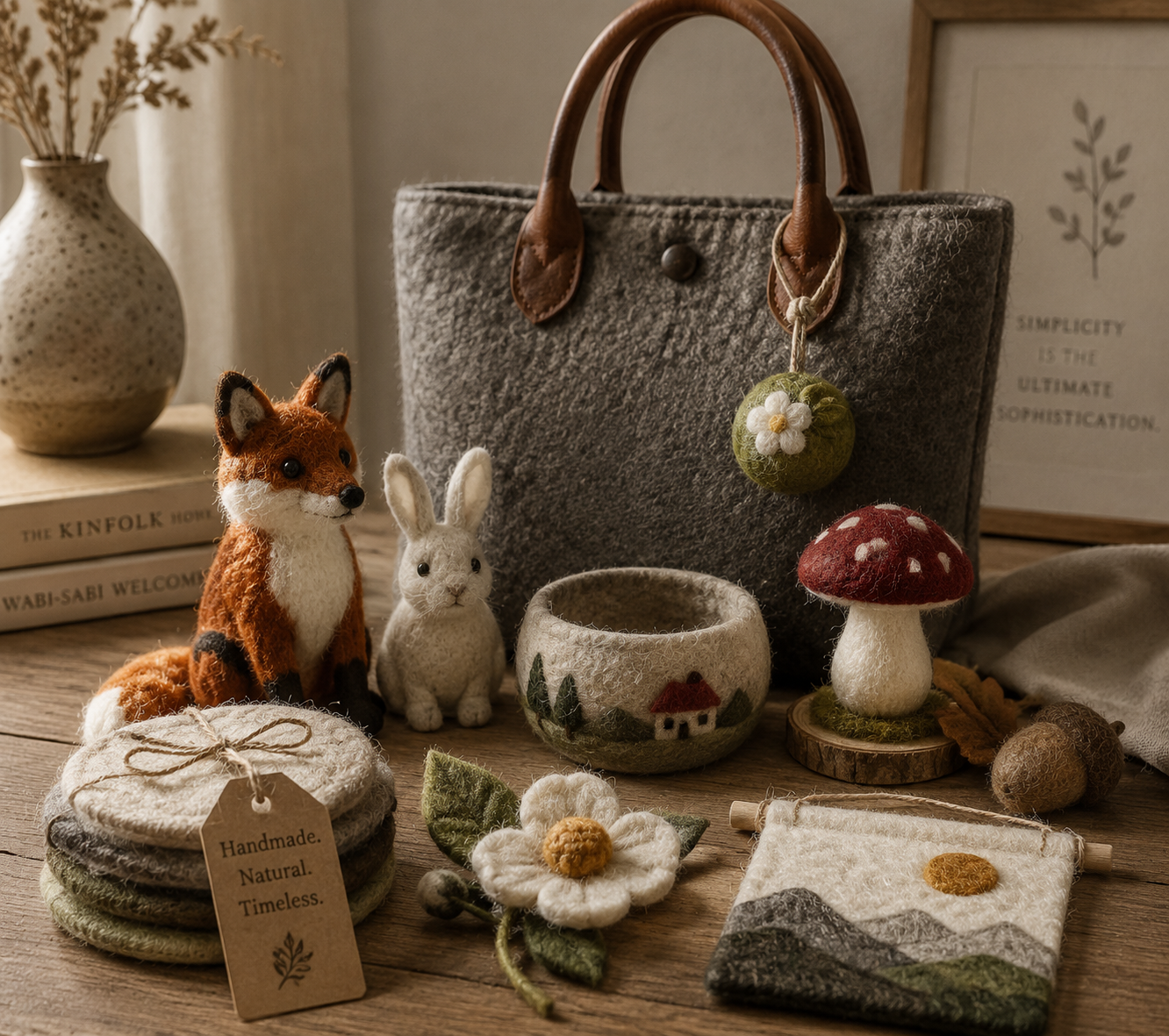
There's a particular kind of satisfaction in holding something that took someone a long time to make.
Not the satisfaction of a high price tag, or a recognizable logo. Something quieter than that — the weight of an object that couldn't have been made by a machine, in a factory, in thirty seconds. An object with a small imperfection that proves it was made by a hand.
That's what handmade wool felt offers. And in a world increasingly saturated with fast, synthetic, and disposable, it turns out people are looking for exactly that.
Quiet Luxury Was Always About Material, Not Branding
The "quiet luxury" conversation in fashion has been loud lately. But strip away the designer labels and the runway analysis, and the conversation keeps arriving at the same place: texture matters. Natural materials matter. Things that last and soften with age matter.
Handmade wool felt products fit this conversation almost too perfectly — except they've been sitting quietly outside it this whole time.
Natural wool fiber is one of the oldest materials in human craft history, and yet the specific sensory experience it offers — a matte, velvety surface that holds its shape while remaining pliable; a weight that feels earned rather than manufactured — is genuinely difficult to replicate synthetically. Brands spend fortunes trying.
When something is made from 100% natural wool using traditional needle felting or wet felting techniques, it carries a textural honesty that no polyester alternative can match. You can feel the difference with your eyes closed.
What Makes Handmade Wool Felt Different from Everything Else on the Market
Most decorative objects today have two things in common: they were made quickly, and they were designed to look the same as each other.
Artisan wool felt works against both of those tendencies.
Needle felting — the process of repeatedly pushing a barbed needle through loose wool fibers to interlock them — is a technique that cannot be meaningfully rushed. Each pass of the needle is deliberate. The density, the shape, the surface texture: all of these are built up slowly, by touch and by judgment, over hours of work. A single needle felted figure or wool felt brooch might represent four to eight hours of skilled making.
Wet felting, which uses hot water, soap, and controlled agitation to fuse wool fibers into a cohesive material, requires an equally attentive hand. The maker must read the material as it transforms — adjusting pressure, temperature, and direction — because wool at that stage is responsive in ways that demand presence.
This is the opposite of manufacturing. There is no digital print, no injection mold, no automated cutter. What exists at the end is something that a particular person made, with a particular set of hands, on a particular day.
That specificity is rare now. It's becoming rarer.
The Objects That Stay
One of the most underappreciated qualities of high-quality wool felt products is how they age.
Fast goods age badly. Synthetic fibers pill, fade, and stiffen. Cheap dyes bleed. The object that looked perfect in the product photo looks tired within a year.
Natural wool felt does something different. Handled regularly, it develops a subtle patina — a softening at the edges, a deepening of color in the denser areas, a surface that begins to carry the trace of being used. It doesn't degrade so much as settle. The object becomes more itself over time, not less.
This is a property that matters more than people think when they're buying, and matters enormously once they own something long enough to notice it. A wool felt accessory — a bag, a coaster set, a small sculpture — that still looks considered five years after purchase is worth ten objects that have to be replaced annually.
Why Wool Felt Gifts Hit Different
Gift-giving has a well-documented anxiety problem. The default options — candles, generic print-on-demand items, mass-produced home accessories — have become almost universally recognized as low-effort. Recipients know immediately when something required no thought.
Handmade wool felt gifts short-circuit that dynamic entirely.
The very fact that someone made the object — that it exists in the world because a person sat down with wool and tools and intention — communicates something that a product description never quite can. It says: I found something that someone made by hand. I thought you were worth that.
Wool felt home décor pieces — ornaments, wall hangings, sculptural objects, seasonal decorations — occupy a specific niche in the gifting landscape: they are personal without being presumptuous, decorative without being generic, and durable enough to genuinely last. They tend to be displayed, not stored.
For gifting occasions that require something that doesn't feel like it came from a checkout page — housewarmings, creative friends, people who already have everything they need — artisan wool felt consistently overdelivers.
Reading the Room: How to Identify Quality Wool Felt Work
Not all wool felt products are made equal. As the category grows in visibility, so does the volume of machine-made or synthetic-blend work wearing the aesthetic of handmade craft. A few markers of genuine quality:
Fiber content. Genuine natural wool fiber — ideally merino or a merino blend — has a specific warmth and density that acrylic-blended felt simply doesn't achieve. The surface should feel substantial, not hollow.
Structural consistency. In quality needle felted work, the density is even throughout the piece. There are no soft spots where fibers haven't been fully interlocked. The object holds its form without stiffening agents or armature.
Color depth. Well-dyed natural wool has a richness that synthetic pigments rarely replicate. Colors have variation — slightly deeper in the dense areas, lighter where fibers are more loosely packed — because they've absorbed into natural protein fibers rather than coating a synthetic surface.
Evidence of making. Handmade objects carry the trace of process: a slightly asymmetric silhouette, a surface that varies subtly across its face, joinery points that show considered construction rather than assembly. These aren't flaws. They're proof.
The Slow Object as a Cultural Statement
There is something worth naming directly about choosing handmade wool felt in 2025 and beyond.
The market for fast, disposable goods has never been larger. The infrastructure for overnight delivery, algorithmic trend cycles, and planned obsolescence has never been more sophisticated. The cultural pressure to accumulate, update, and discard runs continuously in the background of contemporary consumer life.
Choosing a slow-made, natural-material object — one that took days to design, hours to make, and will last years to come — is a choice that pushes back against all of that. Not loudly. Not with a manifesto.
Just with the quiet weight of something that was made with care, and shows it.
That's the real quiet luxury: not spending more, but choosing better.
Frequently Asked Questions
Q: What is the difference between needle felting and wet felting?
Needle felting uses a barbed needle to mechanically interlock wool fibers into a dense, sculpted material — ideal for three-dimensional figures, detailed surface work, and mixed-media embellishment. Wet felting uses hot water, soap, and agitation to fuse fibers into flat or formed sheets — the traditional technique behind wool felt fabric, bags, slippers, and home textiles. Many artisan wool felt makers use both techniques depending on the piece.
Q: How do I care for handmade wool felt products?
Most handmade wool felt pieces require very minimal care. For decorative objects, dust gently with a soft brush. For wool felt accessories or wearables, spot-clean with cool water and a small amount of wool wash; avoid heat, agitation, and machine washing, which can cause shrinkage. Kept away from sustained moisture and direct sunlight, quality wool felt lasts for many years.
Q: Are wool felt products sustainable?
Natural wool fiber is a renewable, biodegradable material — one of the few textile inputs that returns fully to the earth at end of life. Handmade production generates minimal industrial waste compared to mass manufacturing. For buyers interested in sustainable handmade gifts, wool felt produced by small independent makers represents a genuinely lower-impact alternative to synthetic decorative goods.
Q: Can wool felt products be customized?
Many handmade wool felt makers offer bespoke or custom work — specific color palettes, personalized forms, commissioned pieces built around a brief. Because each piece is made individually by hand rather than produced in a run, customization is often more accessible than with manufactured goods. If a specific piece or color combination isn't shown in a maker's existing catalog, it's usually worth asking.
Q: Why do handmade wool felt products cost more than mass-produced alternatives?
The price reflects the time. A single needle felted piece can represent four to ten hours of skilled work, using natural fiber that itself costs significantly more than synthetic alternatives. The maker's skill, the material quality, and the time invested are all embedded in the object — which is precisely why it outlasts and outperforms the alternatives that cost less. With artisan wool felt, you are not paying for branding. You are paying for something that a person made for you.
Final Thought
The most lasting objects in anyone's home tend to share a quality that's hard to articulate but immediately felt: they seem to know what they are.
No trend chasers. No borrowed aesthetics. Just material, form, and the trace of someone's hands.
Handmade wool felt products have that quality in full. They don't demand your attention. They reward it.

