

Cart
0
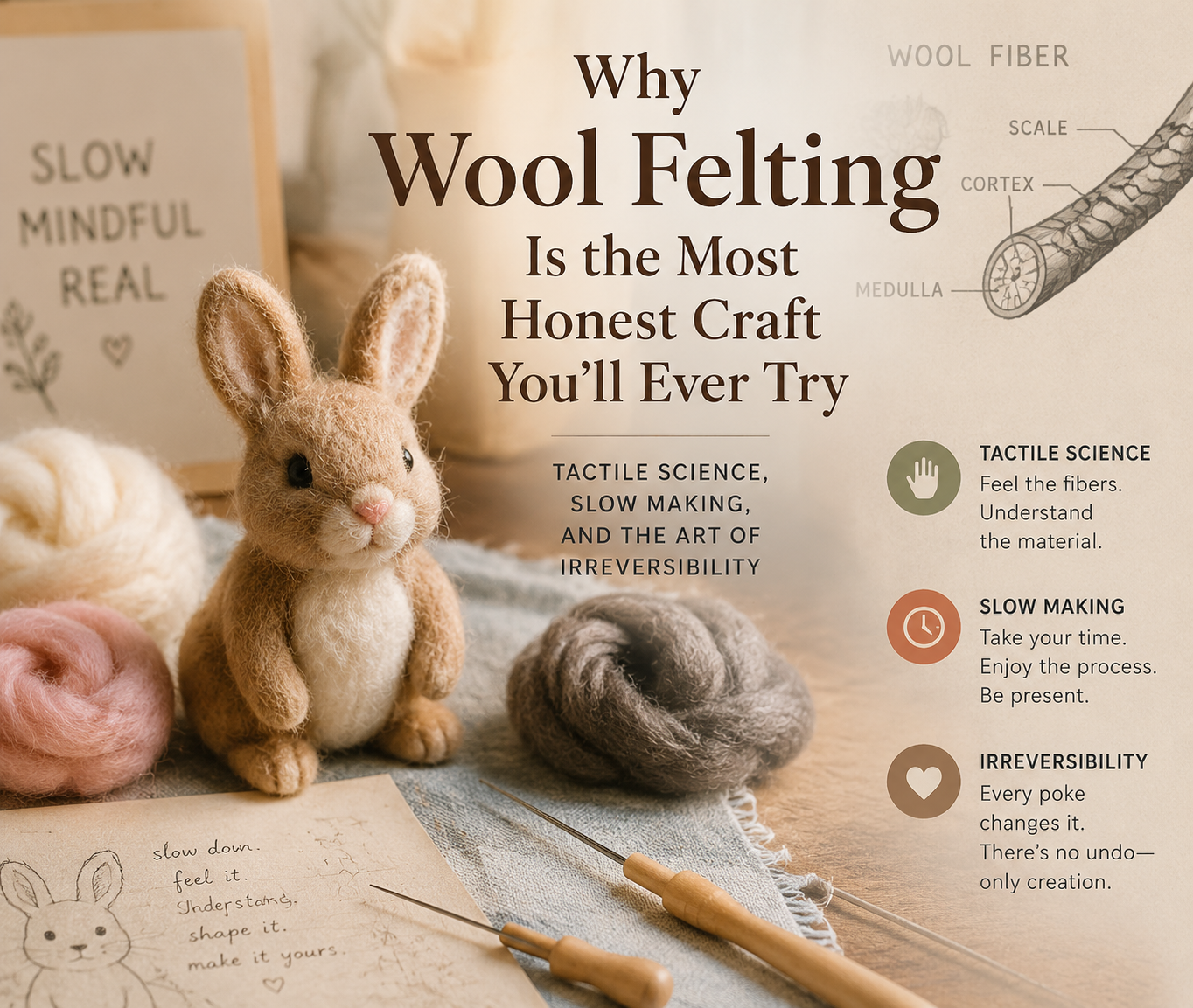
Somewhere between your first needle stab and the hundredth, something shifts.
It isn't the wool. The wool doesn't change. It's you — your nervous system, your grip, your breathing. Wool felting has a way of making you pay attention to your hands in a way that typing, scrolling, and swiping never do. And according to researchers who study the neuroscience of touch, that might be exactly why it feels so restorative.
This isn't a "beginner's guide to felting." You can find a hundred of those. This is about why wool felting works the way it does — on the material, on your body, and on the quiet parts of your mind that don't get used enough.
The Irreversibility Factor: Why Wool Felting Demands Presence
Most popular crafts are forgiving. Knitting lets you frog a row. Embroidery lets you unstitch. Even ceramics can be recycled before firing.
Wool felting does not forgive.
Once wool fibers interlock — whether through the mechanical abrasion of wet felting or the barbed puncture of needle felting — they cannot be meaningfully separated. The felt is permanent. This sounds like a limitation, but it is actually the core of what makes felting psychologically distinct from other fiber crafts.
Psychologists who study engagement and flow states describe "irreversible commitment" as a powerful trigger for focused attention. When you know an action cannot be undone, your brain engages more fully before and during the act. In felting, every stroke of the needle, every press of your palm against wet wool, is a small irreversible decision. The material is keeping score.
This is not anxiety-inducing once you understand it. It is, paradoxically, freeing. When you can't undo anything, you stop trying to perfect everything. You start working with the material instead of against your own second-guessing.
Tactile Neuroscience: What's Actually Happening in Your Hands
The human hand contains approximately 17,000 touch receptors, more than almost any other part of the body. Wool — particularly raw, unprocessed fleece — engages multiple classes of these receptors simultaneously:
- Meissner's corpuscles respond to light, stroking contact (the soft drag of loose fiber across your palm)
- Merkel's discs detect fine spatial detail and texture (the way different wool grades feel distinct before they felt)
- Ruffini endings register sustained pressure and lateral skin stretch (needle felting, pressing wet felt)
- Pacinian corpuscles sense deep pressure and vibration (the rhythmic compression of fulling)
When multiple receptor types are stimulated simultaneously in a slow, rhythmic pattern, research in affective touch neuroscience suggests the brain interprets this as a signal of safety. It is the same neurological family of experience as being held, being massaged, or petting an animal.
This is why many occupational therapists have incorporated needle felting into sensory integration therapy. And it is why people who felt regularly often describe it not as "relaxing" in a passive sense, but as a different kind of alertness — calm and focused at the same time.
For search context: If you've looked for "needle felting therapy," "felting for anxiety," or "tactile crafts for adults" — this mechanism is the scientific basis behind what people report feeling.
The Two Disciplines: Wet Felting vs. Needle Felting Are Not Interchangeable
Many guides treat wet felting and needle felting as two paths to the same destination. They aren't. They are fundamentally different experiences that happen to share a material.
Wet Felting: The Full-Body Practice
Wet felting — where wool is laid out, wetted with hot soapy water, and agitated by hand until fibers bond — is a whole-body craft. You use your forearms, your body weight, sometimes your feet (in the traditional technique of walk felting). The process is warm, wet, and loud with friction.
Wet felting rewards those who can tolerate ambiguity. The felt will shrink and shift in ways you cannot entirely predict. A piece that started as 60 cm may finish at 38 cm. The color will change as fibers compress. What you envisioned and what you make are in constant negotiation.
Best suited to: Large-scale work (wall hangings, vessels, wearables), 3D sculptural forms using resist felting, people who enjoy process over precision.
Key techniques to explore: Nuno felting (wool bonded onto a fabric base such as silk or linen), resist felting over a foam or inflatable form, cobweb felting for translucent, lace-like textiles.
Needle Felting: The Meditative Puncture
Needle felting uses barbed needles — sometimes one, sometimes grouped into a multi-needle tool — to mechanically tangle wool fibers without water. The needle enters the wool, the barbs catch and redirect fibers, and with repetition, a dense, sculpted surface forms.
Needle felting is quiet, controlled, and deeply repetitive. It requires no setup beyond a foam pad and your wool. This accessibility has made it the dominant entry point for new felters, but it is also genuinely its own art form at the highest level — used to create miniature animals with extraordinary anatomical detail, two-dimensional paintings on wool, and mixed-media textile work that hangs in galleries.
Best suited to: Detailed illustration, small sculptural pieces, appliqué on existing textiles, meditative desk-making, people who prefer predictable incremental progress.
Key techniques to explore: 2D wool painting (felting images directly onto a backing), 3D armature felting (building figures over a wire skeleton), core wool with colored wool overlay for efficient sculptural work.
The Wool Itself: Not All Fiber Is Equal, and This Matters More Than Your Tools
A consistent mistake new felters make is investing in good needles and foam before understanding wool. The wool is the work. The tools are simply the mechanism.
Micron Count and Why It Determines Everything
Wool is measured in microns (µm) — the diameter of individual fibers. This single number governs how quickly wool felts, how soft the finished surface is, and what it can be used for.
| Wool Type | Micron Range | Felting Speed | Surface Feel | Best Use |
|---|---|---|---|---|
| Merino (fine) | 15–19 µm | Slow | Silk-soft | Wearables, fine detail |
| Corriedale | 25–31 µm | Medium | Smooth | General sculpting, beginners |
| Romney | 32–36 µm | Fast | Slightly coarse | Large wet-felted pieces |
| Coopworth / Gotland | 33–40 µm | Fast | Rustic, textured | Bags, wall art, structural work |
| Raw fleece (unwashed) | Variable | Very fast | Lanolin-rich | Traditional wet felting, fulling |
Fine wools like Merino are forgiving in color blending and gentle on skin, but they resist felting and require more time and pressure. Coarser wools felt aggressively and produce a distinctly different aesthetic — more rustic, more textured, often more interesting in large-scale work.
The practical advice: Start with Corriedale for needle felting (responsive without being too fast) and a Merino/Corriedale blend for wet felting (fast enough to felt well, fine enough to be pleasant).
Felting as Counter-Practice: The Political Dimension of Slow Making
This may seem like an odd direction for a craft guide. But it is worth naming directly.
The contemporary craft revival — across knitting, weaving, ceramics, and felting — is not happening in a vacuum. It is happening inside a culture of extreme digital acceleration, disposable fast fashion, and the systematic removal of tactile experience from daily life.
Wool felting sits at the most extreme end of slow making. A pair of wet-felted slippers takes 3–5 hours of physical labor. A detailed needle-felted animal portrait can take 20–40 hours. The materials are agricultural, biodegradable, and ancient. The techniques are unchanged from those used in Central Asian nomadic cultures thousands of years ago.
To choose felting as a practice is, whether consciously or not, to insert a different kind of time into your life. Not productive time. Not optimized time. Time that is measured in the density of fiber rather than tasks completed.
Many contemporary crafters describe this as the primary reason they stay with felting after the initial novelty fades. It is not about the objects. It is about the hours — what it feels like to spend them differently.
Starting Without Overwhelm: An Honest First Project
The problem with most "beginner felting" content is that it recommends projects that are either too simple to be interesting (flat, formless shapes) or too complex to be achievable (anatomically detailed animals). Here is an honest bridge.
Project: A felted stone or egg — your first 3D form
This project teaches core sculpting without requiring an armature or complex shaping. It produces a satisfying, palm-sized object and takes 2–4 hours.
What you need:
- Core wool (undyed, medium-grade — this forms the interior bulk)
- Colored Corriedale or Merino for the surface
- A multi-needle tool (3–5 needles) for building, a single needle for detail
- Dense foam felting pad, at least 5 cm thick
- A rough idea, not a plan
The process in honest terms: Begin by wrapping core wool tightly into a rough ball. Stab it repeatedly with your multi-needle tool, rotating constantly. Do not stab in straight lines — vary your angle. The wool will resist and then gradually compact. This takes longer than you expect. Resist the urge to stop too early.
Once you have a firm core, begin applying your surface color in thin, pulled layers. Stab them in. Build up, rotate, build up. The surface will felt unevenly at first. Keep going. The form self-corrects as density increases.
When the entire surface is consistent and the piece no longer compresses when squeezed, it is done. It will not look like a photograph from a tutorial. It will look like yours, which is better.
Where Felting Goes After the Beginning
The depth of this craft is genuinely surprising. Here are directions that experienced felters pursue that rarely appear in introductory content:
Botanical dyeing before felting: Natural dyes from weld, woad, madder, and iron mordants behave differently on wet-felted versus needle-felted surfaces. Pre-dyed handspun wool creates gradient effects unavailable with commercial roving.
Architectural textile work: Large-scale wet-felted pieces — room dividers, hanging sculptures, vessel forms — are an emerging area within contemporary textile art with significant gallery representation.
Eco-printing on nuno felt: Laying botanical material (leaves, flowers) between wool and silk during the wet felting process produces contact prints that are literally pressed into the structure of the textile. Each piece is unrepeatable.
Collaborative and community felting: Traditional Mongolian and Kyrgyz felting was never a solo practice. Large gers (yurts) were felted communally over days. Modern revival communities are reintroducing this social dimension through felting circles and collaborative installation projects.
A Final Note on Failure in Felting
Wool felting produces some spectacular failures. Pieces that distort beyond recognition. Color bleeds that turn a careful palette into mud. Sculptures that collapse or list to one side. The felt that was supposed to be a vessel and is clearly something else.
Here is what experienced felters will tell you about these failures, uniformly: they teach you more than the successes. Because the material cannot be undone, you are forced to understand why it went wrong — really understand it, in the way that only irreversibility demands. The material is not punishing you. It is educating you.
This is, perhaps, the deepest thing felting has to teach. Not patience. Not creativity. But the willingness to keep working with what is actually in front of you, rather than what you wished were there.
That turns out to be a more useful skill than it sounds.

